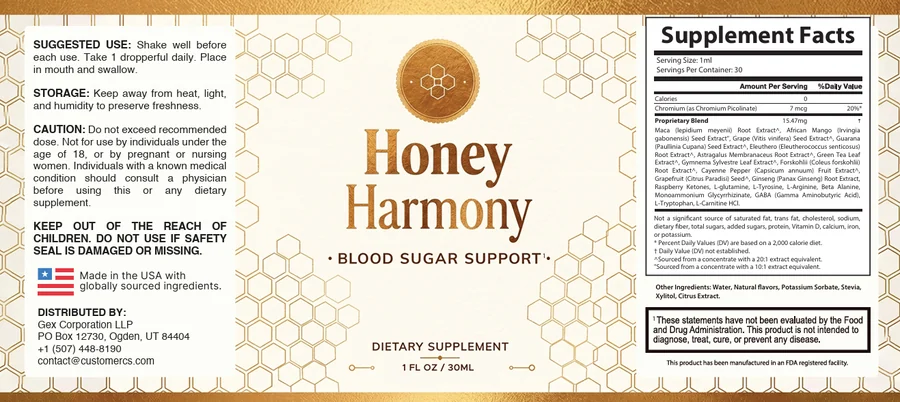
The full label, line by line
The bottle is a 30 mL (1 fl oz) amber dropper. The serving is 1 mL, so a bottle holds 30 servings, a month at one dropperful a day. The label lists two things with amounts: chromium at 7 mcg, which is 20% of the Daily Value, and a proprietary blend at 15.47 mg. Inside that blend sit 21 named ingredients with no individual amounts.
| Line as printed | Source | Extract ratio | Per 1 mL | % DV |
|---|---|---|---|---|
| Chromium (as chromium picolinate) | Mineral salt | n/a | 7 mcg | 20% |
| Maca root extract | Lepidium meyenii | 20:1 extract | not disclosed | † |
| African mango seed extract | Irvingia gabonensis | 10:1 extract | not disclosed | † |
| Grape seed extract | Vitis vinifera | 20:1 extract | not disclosed | † |
| Guarana seed extract | Paullinia cupana | 20:1 extract | not disclosed | † |
| Eleuthero root extract | Eleutherococcus senticosus | 20:1 extract | not disclosed | † |
| Astragalus root extract | Astragalus membranaceus | 20:1 extract | not disclosed | † |
| Green tea leaf extract | Camellia sinensis | 20:1 extract | not disclosed | † |
| Gymnema leaf extract | Gymnema sylvestre | 20:1 extract | not disclosed | † |
| Forskohlii root extract | Coleus forskohlii | 20:1 extract | not disclosed | † |
| Cayenne pepper fruit extract | Capsicum annuum | 20:1 extract | not disclosed | † |
| Grapefruit seed | Citrus paradisi | 20:1 extract | not disclosed | † |
| Ginseng root extract | Panax ginseng | not stated | not disclosed | † |
| Raspberry ketones | Compound | not stated | not disclosed | † |
| L-glutamine | Compound | not stated | not disclosed | † |
| L-tyrosine | Compound | not stated | not disclosed | † |
| L-arginine | Compound | not stated | not disclosed | † |
| Beta-alanine | Compound | not stated | not disclosed | † |
| Monoammonium glycyrrhizinate | licorice-derived | not stated | not disclosed | † |
| GABA | gamma-aminobutyric acid | not stated | not disclosed | † |
| L-tryptophan | Compound | not stated | not disclosed | † |
| L-carnitine HCl | Compound | not stated | not disclosed | † |
The other ingredients are water, natural flavors, potassium sorbate, stevia, xylitol, citrus extract. Water is the base. Potassium sorbate is a common preservative. Stevia and xylitol sweeten the drops, and the monoammonium glycyrrhizinate in the blend, a licorice-derived compound, adds more sweetness. Citrus extract and natural flavors set the taste.
Federal rules let a company list a proprietary blend by its total weight and the order of its ingredients, without the amount of each [1]. That is legal. It also means a buyer cannot tell whether the gymnema on line 8 is 10 mg or 0.1 mg. We flag every one of those 21 lines rather than guess.
What 15.47 mg actually means
15.47 milligrams is about the weight of a few grains of rice. Shared by 21 ingredients, it averages 0.74 mg each. Blends are rarely equal, and the order on a label is by weight, so maca, listed first, probably holds the largest share and L-carnitine, listed last, the smallest. Even so, no single line can exceed 15.47 mg.
The extract ratios do not rescue the arithmetic. A 20:1 ratio means 20 parts of starting plant made 1 part of extract. If all 15.47 mg were 20:1 extract, the blend would stand for about 309 mg of raw plant in total, still shared 21 ways, and still below a single trial dose of gymnema leaf extract, which was about 400 mg of extract, not of raw leaf [2].
This is the single most useful fact on the label. It does not tell you the drops are harmful. It tells you the research on the famous ingredients cannot be borrowed for this bottle.
Gymnema sylvestre
Gymnema is a climbing plant from India whose leaves have been used in Ayurvedic medicine for diabetes. Its gymnemic acids sit on sweet-taste receptors, which is why chewing the leaf makes sugar taste like sand for a while. In lab work they also slow glucose transport in the gut [3].
The human evidence is the best on this label. An early uncontrolled study gave 22 adults with type 2 diabetes 400 mg a day of a leaf extract next to their usual medicine for up to 20 months, and their fasting glucose and HbA1c fell [2]. Meta-analyses of later trials report modest improvements in fasting glucose and HbA1c, with heavy caveats about trial size and quality [4] [5]. A 2020 trial found gymnema reduced the desire for high-sugar sweet foods [6].
Two cautions. At effective doses, gymnema can add to insulin and sulfonylureas and push glucose too low. And LiverTox records cases of liver injury, including a published case of toxic hepatitis in a man taking gymnema for diabetes [7] [8]. In Honey Harmony, gymnema is an unstated share of 15.47 mg.
Chromium picolinate, 7 mcg
Chromium is a trace mineral involved in insulin action. NIH sets adequate intakes at 20 to 35 mcg a day for adults, and most people get that from food [9]. The label's 7 mcg is the only printed dose and a sensible dietary amount.
Trials testing chromium for blood sugar used 200 to 1,000 mcg. The results are mixed: a 2014 meta-analysis found small improvements in some glucose measures with large differences between studies [10], and a 2016 review titled its conclusion “limited evidence of effectiveness” [11]. In 2005 the FDA allowed chromium picolinate only a qualified health claim, stating that the link to insulin resistance is highly uncertain [12]. At 7 mcg, Honey Harmony sits far below even that uncertain range.
Green tea, Panax ginseng and African mango
Green tea leaf extract. Across 17 randomized trials, green tea or its extract lowered fasting glucose and HbA1c slightly [13]. The doses were cups of tea or extracts carrying hundreds of milligrams of catechins. Concentrated extracts are also one of the supplements most often tied to liver injury [14], and European regulators flagged intakes of 800 mg of EGCG a day [15]. Neither the benefit nor that risk is in play at this dose. Panax ginseng root extract. A 2014 meta-analysis found a small fall in fasting glucose and no meaningful change in HbA1c [16]. Doses were mostly 1 to 3 g a day. NIH notes ginseng may lower blood sugar and interact with diabetes medicine [17]. The seller's page calls it an aerial extract; the label says root. African mango seed extract, 10:1. The research is about weight: a month on 3.15 g of seed [18] and ten weeks on 150 mg twice a day of the IGOB131 extract [19] both reported weight loss, and the second recorded lower fasting glucose and leptin. A systematic review judged the trials too weak to recommend [20].Maca and the other 16 lines
Maca is a Peruvian root studied, in grams, for energy, mood and sexual function [21]. We found no glucose trial. The seller's claim that maca steadies cortisol and therefore blood sugar strings together two links that have not been tested together.The remaining 16 lines split into three groups. Botanicals with some research on other outcomes: grape seed for blood pressure [22], astragalus with little high-quality evidence for anything [23], forskolin for body composition [24], eleuthero for fatigue. Weight-loss staples with thin human data: raspberry ketones, cayenne, grapefruit seed. And amino acids, L-glutamine, L-tyrosine, L-arginine, beta-alanine, GABA, L-tryptophan and L-carnitine, which researchers study in grams a day and which people eat in grams with ordinary protein.
| Ingredient | Label amount | Evidence grade (at studied doses) |
|---|---|---|
| Gymnema sylvestre | share of 15.47 mg, not disclosed | 55% |
| Chromium (as chromium picolinate) | 7 mcg, 20% DV, printed | 35% |
| Green tea leaf extract | share of 15.47 mg, not disclosed | 30% |
| Panax ginseng | share of 15.47 mg, not disclosed | 30% |
| African mango | share of 15.47 mg, not disclosed | 20% |
| Maca | share of 15.47 mg, not disclosed | 5% |
| Grape seed extract | not disclosed | 10% |
| Guarana seed extract | not disclosed | 3% |
| Eleuthero root extract | not disclosed | 5% |
| Astragalus root extract | not disclosed | 10% |
| Forskohlii root extract | not disclosed | 5% |
| Cayenne pepper fruit extract | not disclosed | 3% |
| Grapefruit seed | not disclosed | 2% |
| Raspberry ketones | not disclosed | 2% |
| L-glutamine | not disclosed | 3% |
| L-tyrosine | not disclosed | 2% |
| L-arginine | not disclosed | 5% |
| Beta-alanine | not disclosed | 2% |
| Monoammonium glycyrrhizinate | not disclosed | 2% |
| GABA | not disclosed | 2% |
| L-tryptophan | not disclosed | 2% |
| L-carnitine HCl | not disclosed | 5% |
The average grade across all 22 lines is 11%. That grade describes the research at studied doses; at this label's doses every line would score close to zero.
Three ingredients we would discount, and why
If you are weighing the formula, three lines stand out for the wrong reasons:
- Guarana seed extract. It is a caffeine source, and caffeine raised after-meal glucose and insulin in people with type 2 diabetes [25]. The amount here is too small to matter, but it is the opposite of what a blood sugar formula should add, and it sits awkwardly next to the seller's “without artificial stimulants” line.
- Raspberry ketones. A weight-loss fashion built on animal studies. We found no human trial of raspberry ketones on their own for weight or glucose.
- Maca root extract. Listed first, so probably the largest share of the blend, and the ingredient with no blood sugar research at all.
Together they take up the top of the blend list and a large part of its weight, which leaves even less of the 15.47 mg for gymnema, the one ingredient with a credible glucose record. Read more about why labels end up this way in our underdosed actives case study.
Interactions worth clearing first
Ask a pharmacist or prescriber before starting if any of these apply:
- Insulin, sulfonylureas or other glucose-lowering drugs. Gymnema, chromium and ginseng at real doses can add to them. Know the signs of low blood sugar, such as shakiness, sweating, confusion and a fast heartbeat, and how to treat it [26]. Do not lower a prescribed dose because readings improve without talking to your prescriber.
- Liver disease. Gymnema and concentrated green tea extracts appear in liver injury case reports [8] [14]. Stop and get checked for dark urine, yellow skin or eyes, or pain under the right ribs.
- Caffeine sensitivity. Guarana supplies caffeine, likely trivial here, but worth knowing if you avoid it completely.
- Blood pressure and potassium. Licorice compounds raise blood pressure and lower potassium in large amounts [27]; the sweetener share here is small.
- Pregnancy, breastfeeding and under 18. The label says not for use.
- Pets. The liquid contains xylitol, which is dangerous for dogs even in small amounts [28]. Keep the bottle out of reach.
Report a serious reaction to the FDA [29]. NIH's advice for anyone with diabetes is to tell every clinician about every supplement and never replace proven treatment with one [30].
Ready to order on the seller's checkout?
Six bottles cost $294 with free U.S. shipping ($1.63 a day); two bottles cost $167.99 with shipping. The 60-day refund clock starts on the order date.
Sources
- Electronic Code of Federal Regulations. 21 CFR 101.36: Nutrition labeling of dietary supplements. www.ecfr.gov/current/title-21/chapter-I/subchapter-B/part-101/subpart-C/section-101.36
- Baskaran K, Kizar Ahamath B, Radha Shanmugasundaram K, Shanmugasundaram ER. Antidiabetic effect of a leaf extract from Gymnema sylvestre in non-insulin-dependent diabetes mellitus patients. J Ethnopharmacol. 1990;30(3):295-300. pubmed.ncbi.nlm.nih.gov/2259217/
- Tiwari P, Mishra BN, Sangwan NS. Phytochemical and pharmacological properties of Gymnema sylvestre: an important medicinal plant. Biomed Res Int. 2014;2014:830285. pubmed.ncbi.nlm.nih.gov/24511547/
- Devangan S, Varghese B, Johny E, et al. The effect of Gymnema sylvestre supplementation on glycemic control in type 2 diabetes patients: a systematic review and meta-analysis. Phytother Res. 2021;35(12):6802-6812. pubmed.ncbi.nlm.nih.gov/34467577/
- Zamani M, Ashtary-Larky D, Nosratabadi S, et al. The effects of Gymnema sylvestre supplementation on lipid profile, glycemic control, blood pressure, and anthropometric indices in adults: a systematic review and meta-analysis. Phytother Res. 2023;37(3):949-964. pubmed.ncbi.nlm.nih.gov/36580574/
- Turner S, Diako C, Kruger R, et al. Consuming Gymnema sylvestre reduces the desire for high-sugar sweet foods. Nutrients. 2020;12(4):1046. pubmed.ncbi.nlm.nih.gov/32290122/
- Shiyovich A, Sztarkier I, Nesher L. Toxic hepatitis induced by Gymnema sylvestre, a natural remedy for type 2 diabetes mellitus. Am J Med Sci. 2010;340(6):514-517. pubmed.ncbi.nlm.nih.gov/20856101/
- LiverTox: Clinical and Research Information on Drug-Induced Liver Injury. Gymnema. Bethesda (MD): National Institute of Diabetes and Digestive and Kidney Diseases. pubmed.ncbi.nlm.nih.gov/39666848/
- NIH Office of Dietary Supplements. Chromium: Fact Sheet for Health Professionals. ods.od.nih.gov/factsheets/Chromium-HealthProfessional/
- Suksomboon N, Poolsup N, Yuwanakorn A. Systematic review and meta-analysis of the efficacy and safety of chromium supplementation in diabetes. J Clin Pharm Ther. 2014;39(3):292-306. pubmed.ncbi.nlm.nih.gov/24635480/
- Costello RB, Dwyer JT, Bailey RL. Chromium supplements for glycemic control in type 2 diabetes: limited evidence of effectiveness. Nutr Rev. 2016;74(7):455-468. pubmed.ncbi.nlm.nih.gov/27261273/
- Trumbo PR, Ellwood KC. Chromium picolinate intake and risk of type 2 diabetes: an evidence-based review by the United States Food and Drug Administration. Nutr Rev. 2006;64(8):357-363. pubmed.ncbi.nlm.nih.gov/16958312/
- Liu K, Zhou R, Wang B, et al. Effect of green tea on glucose control and insulin sensitivity: a meta-analysis of 17 randomized controlled trials. Am J Clin Nutr. 2013;98(2):340-348. pubmed.ncbi.nlm.nih.gov/23803878/
- Navarro VJ, Khan I, Björnsson E, et al. Liver injury from herbal and dietary supplements. Hepatology. 2017;65(1):363-373. pubmed.ncbi.nlm.nih.gov/27677775/
- EFSA Panel on Food Additives and Nutrient Sources added to Food. Scientific opinion on the safety of green tea catechins. EFSA Journal. 2018;16(4):5239. www.efsa.europa.eu/en/efsajournal/pub/5239
- Shishtar E, Sievenpiper JL, Djedovic V, et al. The effect of ginseng (the genus Panax) on glycemic control: a systematic review and meta-analysis of randomized controlled clinical trials. PLoS One. 2014;9(9):e107391. pubmed.ncbi.nlm.nih.gov/25265315/
- National Center for Complementary and Integrative Health. Asian Ginseng. www.nccih.nih.gov/health/asian-ginseng
- Ngondi JL, Oben JE, Minka SR. The effect of Irvingia gabonensis seeds on body weight and blood lipids of obese subjects in Cameroon. Lipids Health Dis. 2005;4:12. pubmed.ncbi.nlm.nih.gov/15916709/
- Ngondi JL, Etoundi BC, Nyangono CB, et al. IGOB131, a novel seed extract of the West African plant Irvingia gabonensis, significantly reduces body weight and improves metabolic parameters in overweight humans in a randomized double-blind placebo controlled investigation. Lipids Health Dis. 2009;8:7. pubmed.ncbi.nlm.nih.gov/19254366/
- Onakpoya I, Davies L, Posadzki P, Ernst E. The efficacy of Irvingia gabonensis supplementation in the management of overweight and obesity: a systematic review of randomized controlled trials. J Diet Suppl. 2013;10(1):29-38. pubmed.ncbi.nlm.nih.gov/23419021/
- Gonzales GF. Ethnobiology and ethnopharmacology of Lepidium meyenii (maca), a plant from the Peruvian highlands. Evid Based Complement Alternat Med. 2012;2012:193496. pubmed.ncbi.nlm.nih.gov/21977053/
- National Center for Complementary and Integrative Health. Grape Seed Extract. www.nccih.nih.gov/health/grape-seed-extract
- National Center for Complementary and Integrative Health. Astragalus. www.nccih.nih.gov/health/astragalus
- Godard MP, Johnson BA, Richmond SR. Body composition and hormonal adaptations associated with forskolin consumption in overweight and obese men. Obes Res. 2005;13(8):1335-1343. pubmed.ncbi.nlm.nih.gov/16129715/
- Lane JD, Barkauskas CE, Surwit RS, Feinglos MN. Caffeine impairs glucose metabolism in type 2 diabetes. Diabetes Care. 2004;27(8):2047-2048. pubmed.ncbi.nlm.nih.gov/15277438/
- National Institute of Diabetes and Digestive and Kidney Diseases. Low Blood Glucose (Hypoglycemia). www.niddk.nih.gov/health-information/diabetes/overview/preventing-problems/low-blood-glucose-hypoglycemia
- National Center for Complementary and Integrative Health. Licorice Root. www.nccih.nih.gov/health/licorice-root
- U.S. Food and Drug Administration. Paws Off Xylitol; It's Dangerous for Dogs. www.fda.gov/consumers/consumer-updates/paws-xylitol-its-dangerous-dogs
- U.S. Food and Drug Administration. How to Report a Problem with Dietary Supplements. www.fda.gov/food/dietary-supplements/how-report-problem-dietary-supplements
- National Center for Complementary and Integrative Health. Diabetes and Dietary Supplements: What You Need To Know. www.nccih.nih.gov/health/diabetes-and-dietary-supplements-what-you-need-to-know